Antikythera · 35°52′N 23°18′EThe Risk ProtocolThe Risk Protocol · MMXXVI

The Antikythera Mark

More than two thousand years ago, a hand-cranked bronze machine made the sky predictable. It is the oldest known analogue computer, and it is the inspiration for the new mark of The Risk Protocol.

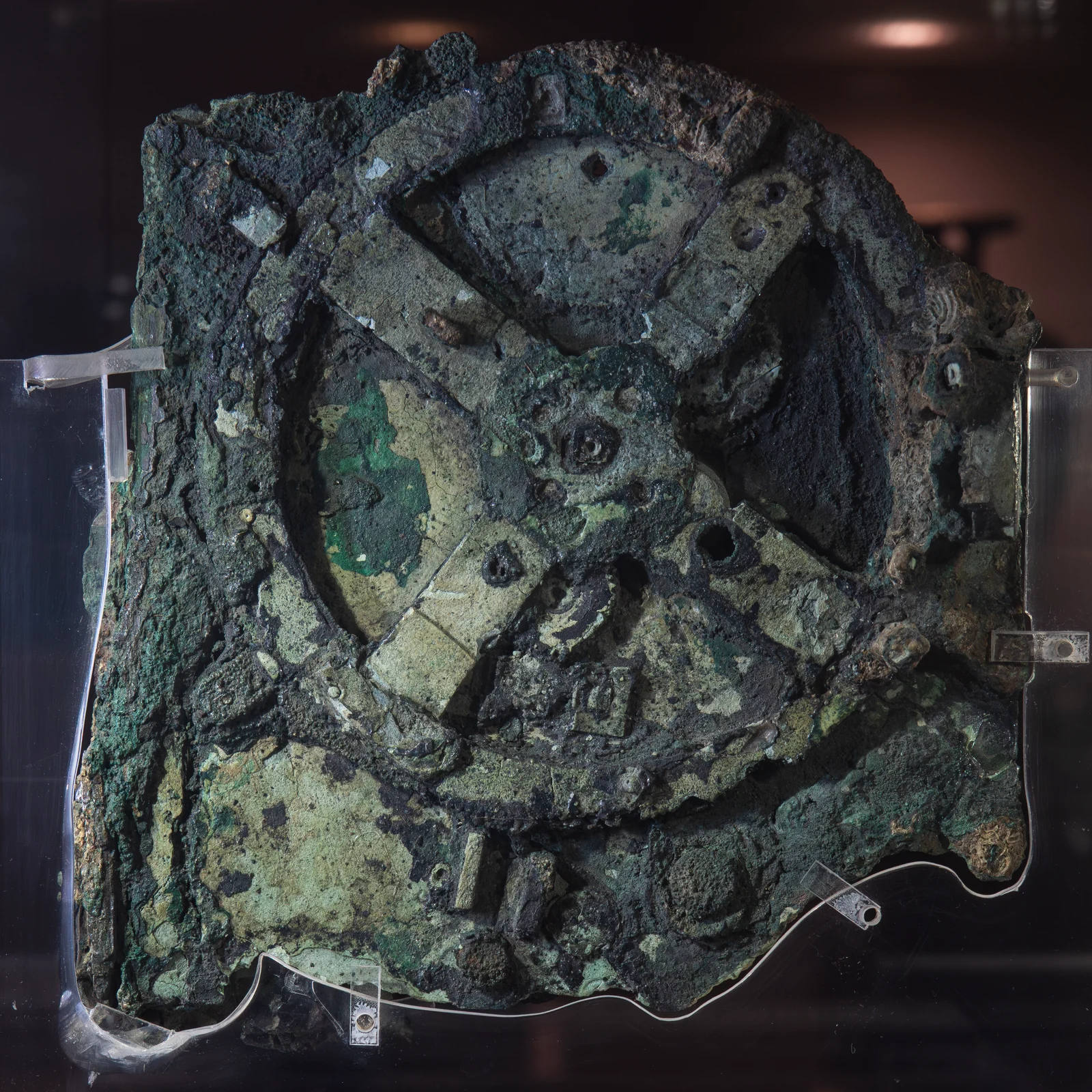
Fragment A of the Antikythera mechanism: corroded green bronze with the four-spoked great wheel at its centre
Built · 2nd century BCFragment A of the Antikythera mechanism, found in 1901, now in the National Archaeological Museum, Athens. Photo: Logg Tandy, CC BY 4.0.
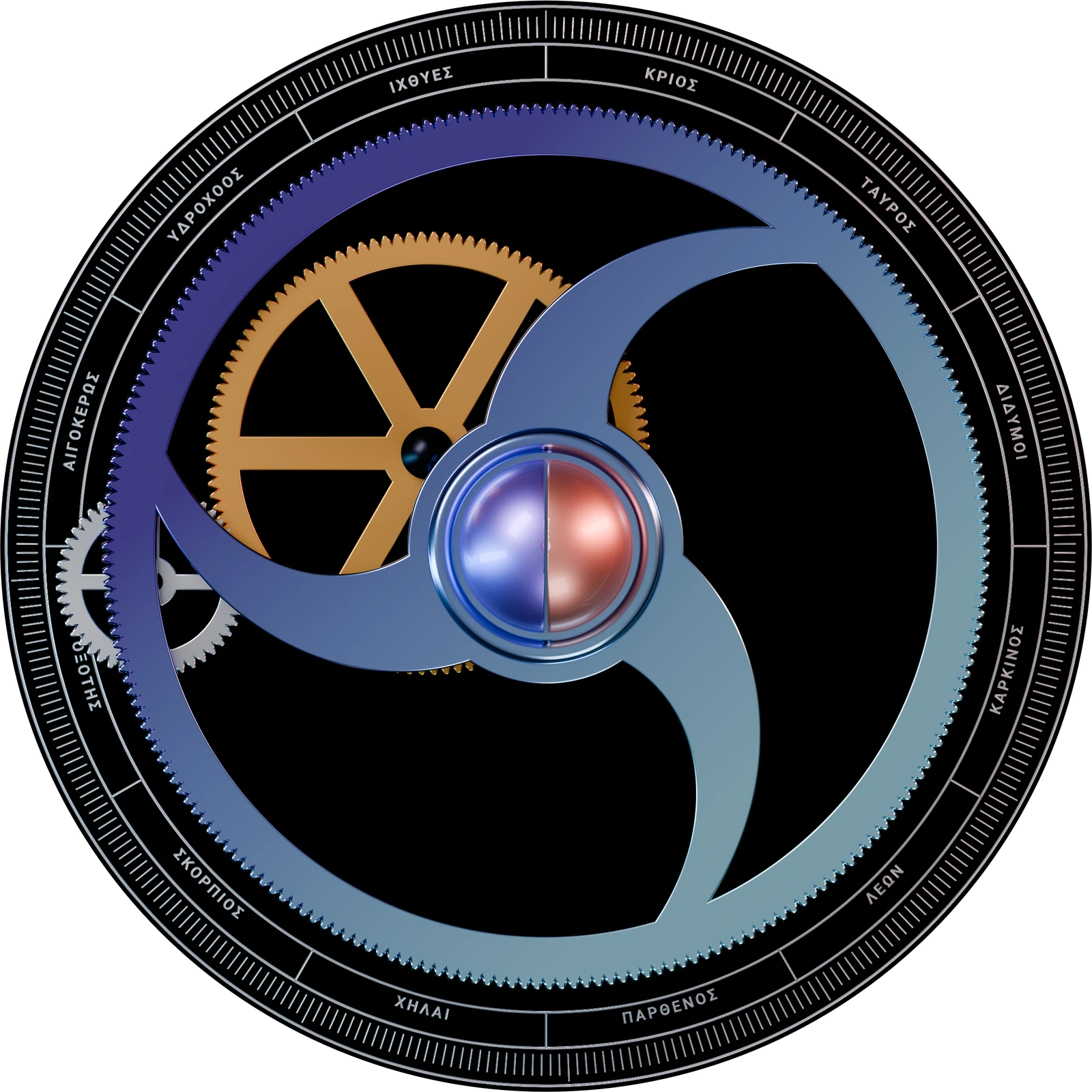
The Antikythera Mark rendered in anodised metal, seen from above
Made · 2026The Antikythera Mark for The Risk Protocol, rendered in anodised metal.

More than 2,100 years apart

A computer from the bottom of the sea

  1. 1900

    Bodies on the seabed

    Around Easter 1900, Captain Dimitrios Kondos and his crew of sponge divers from the island of Symi stopped at Antikythera, a small island between Crete and the Peloponnese, to wait for better winds. The diver Elias Stadiatis went down more than forty metres and came back saying he had seen a pile of decaying bodies and horses on the seabed. What he had seen were statues, the cargo of a ship that sank in the first century BC.

  2. 1901

    A salvage that cost a life

    With the Greek navy in support, the divers brought up bronze and marble statues through the winter and into 1901, among them the bronze Youth of Antikythera. One diver, Giorgos Kritikos, died of decompression sickness and two more were paralysed, and the work stopped in September 1901. Among the finds, and drawing little attention, were a few lumps of corroded bronze and wood.

  3. 1902

    A gear in the stone

    In 1902, Spyridon Stais, the politician who as minister of education had overseen the salvage, was visiting the National Archaeological Museum when he noticed the traces of gearwork on two of those lumps. It was the first sign that the sea had given back a machine.

  4. 1951

    Seeing through bronze

    The historian of science Derek de Solla Price took up the puzzle in 1951. Twenty years later, the Greek nuclear physicist Charalampos Karakalos made gamma-ray and X-ray images of the fragments for him, and in 1974 Price published what they showed: a train of interlocking gears unlike anything else known from the ancient world.

  5. 2005

    Reading the inside

    The Antikythera Mechanism Research Project, an international team led by Mike Edmunds of Cardiff University, used X-ray tomography and high-resolution surface imaging to study the 82 surviving fragments. Faint inscriptions that once covered the case could now be read, among them what appears to be an instruction manual on its back door.

  6. 2021

    A model of the cosmos

    A team at University College London, with Tony Freeth as lead author, published a new model of the entire machine. The fragments themselves are kept today in the National Archaeological Museum in Athens.

What the machine could do

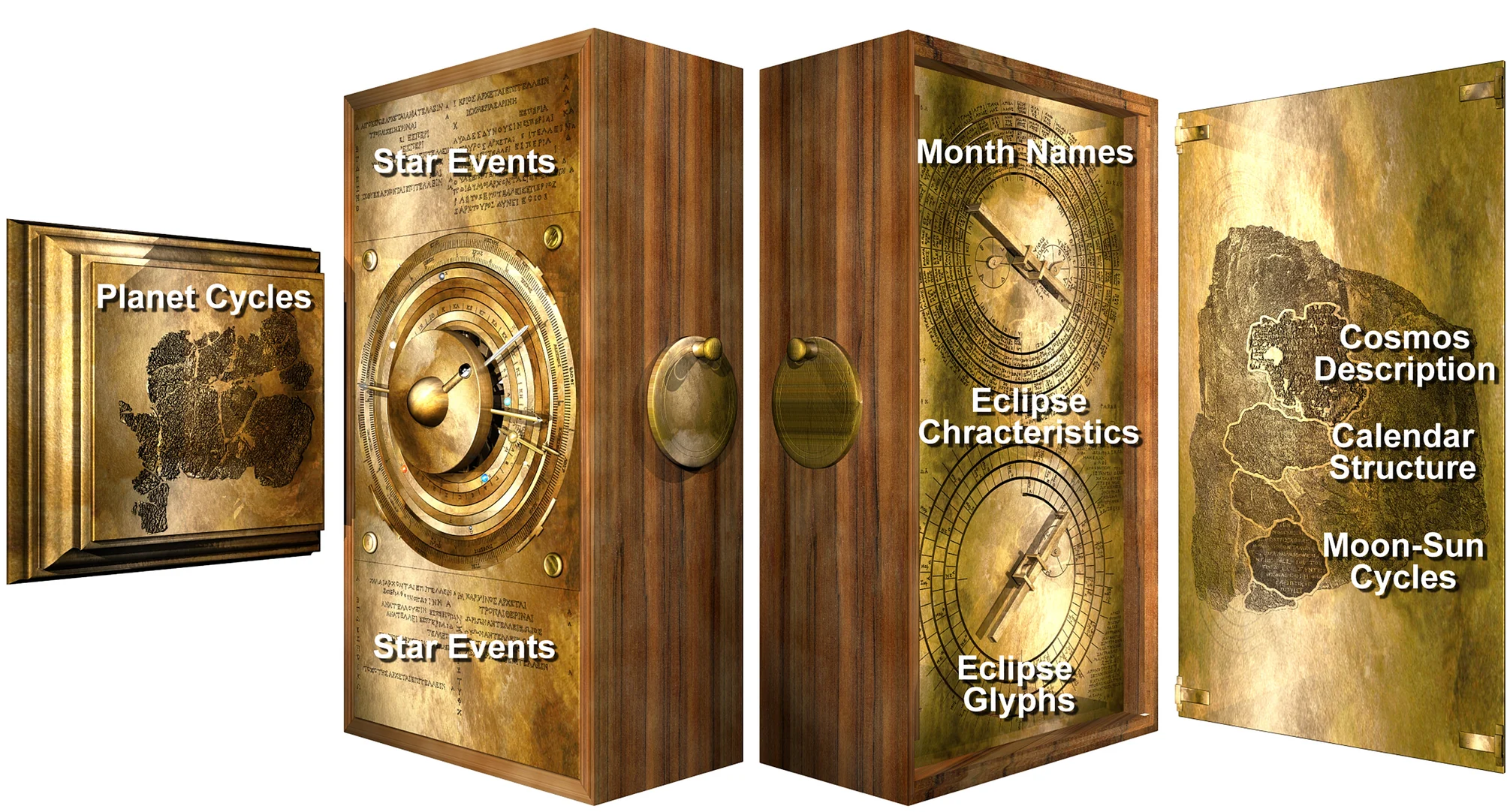
Reconstruction of the whole machine: the front cover, the front plate with its dials, the back plate with two spiral dials, and the inscribed back coverFront coverFront plateBack plateBack cover01Planet cycles02Star calendar03Star calendar04Month names05Eclipse notes06Eclipse glyphs07The cosmos08The calendar09Moon and Sun

Front cover

01 Planet cycles. The inscription gives the cycles of the five planets known at the time: how long each takes to return to the same place relative to the Sun.

Front plate

02, 03 Star calendar. Above and below the dial, a star calendar called a parapegma lists the risings and settings of stars through the year, keyed to the zodiac. The dial between them showed the Sun, the Moon and the planets.

Back plate

04 Month names. The upper spiral is a calendar of 235 months over nineteen years, with the name of each month in its cell.

05 Eclipse notes. Inscriptions around the two dials describe the character of each eclipse the lower spiral predicts.

06 Eclipse glyphs. The lower spiral counts the 223 months of the Saros cycle, about eighteen years, and glyphs in its cells mark the months with an eclipse.

Back cover

07 to 09 The user's manual. The back cover explained the machine: a description of the display on the front, the structure of the calendar, and the cycles of the Moon and the Sun.

Fig. 01The whole machine as reconstructed in 2021 by Tony Freeth and colleagues at University College London: the front plate with its dials, the back plate with its two spirals, and the inscribed covers. Scientific Reports, 2021, CC BY 4.0, cropped and relabelled.
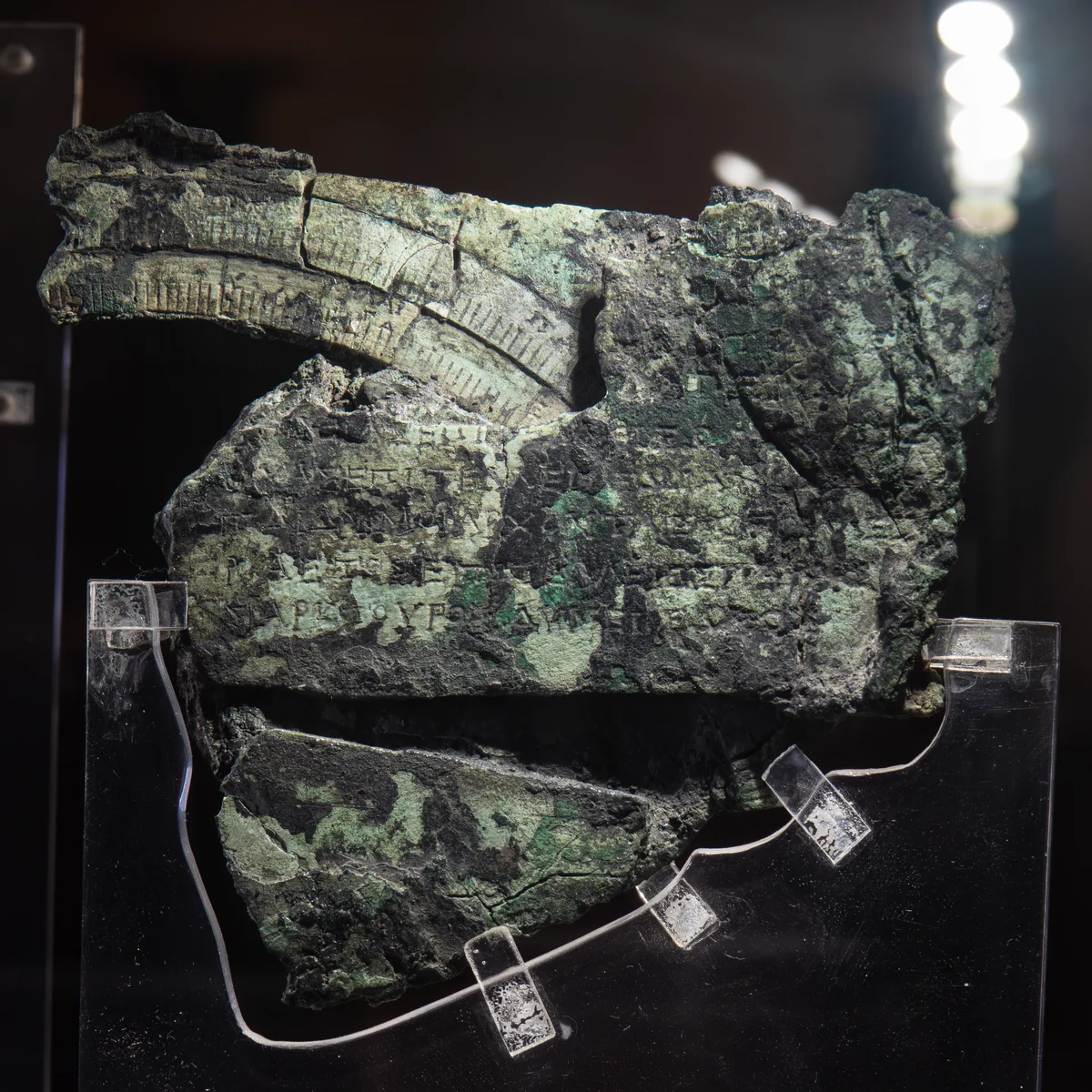
Fragment C: corroded bronze with parts of two circular scales
Fig. 02Fragment C, with part of the front dial's two scales. Photo: Logg Tandy, CC BY 4.0.

The front

Pointers for the Sun and the Moon moved around the signs of the Greek zodiac and a ring of day marks. A small ball, half white and half black, turned to show the phase of the Moon, and a pin-and-slot pair of gears made the Moon speed up and slow down across the month, the uneven motion that the astronomer Hipparchus described.

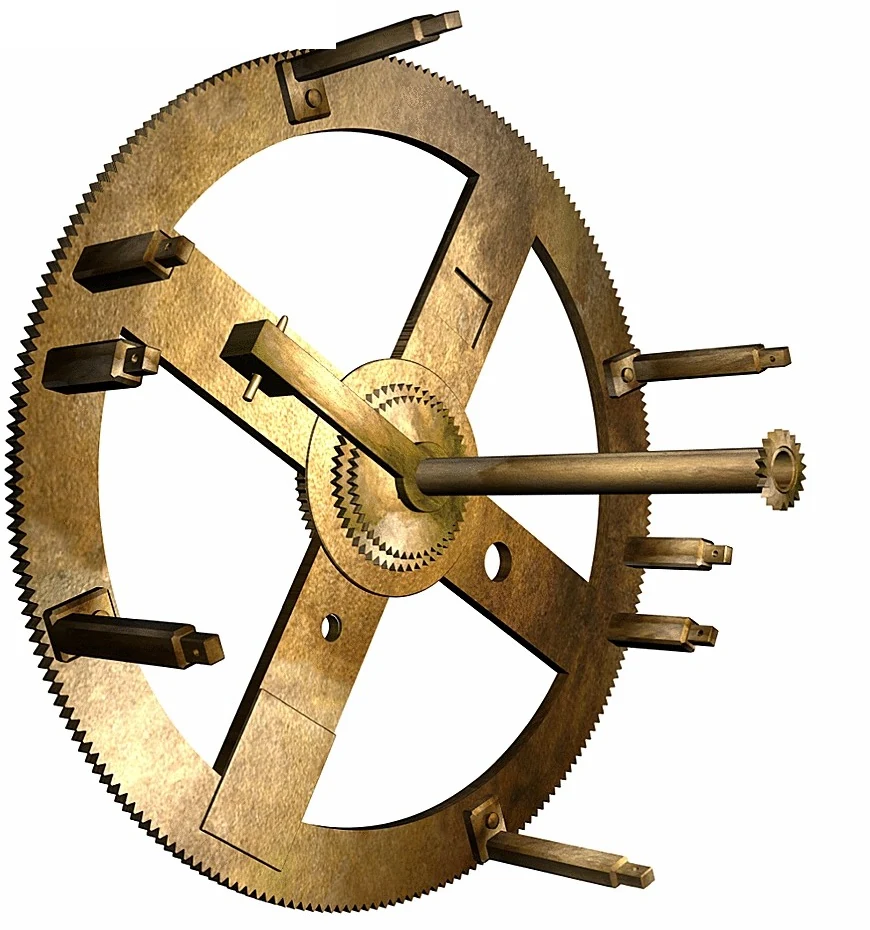
Reconstruction of the great four-spoked wheel with its triangular teeth
Fig. 03The great wheel as reconstructed by the same team. Scientific Reports, 2021, CC BY 4.0, cropped.

The great wheel

The machine sat in a wooden case about the size of a shoebox and was driven by a small hand crank, now lost. The crank turned the largest gear, a four-spoked wheel about thirteen centimetres across with an estimated 223 teeth, and that one wheel drove every other gear. Its teeth were small triangles, just under two millimetres apart, probably cut by hand.

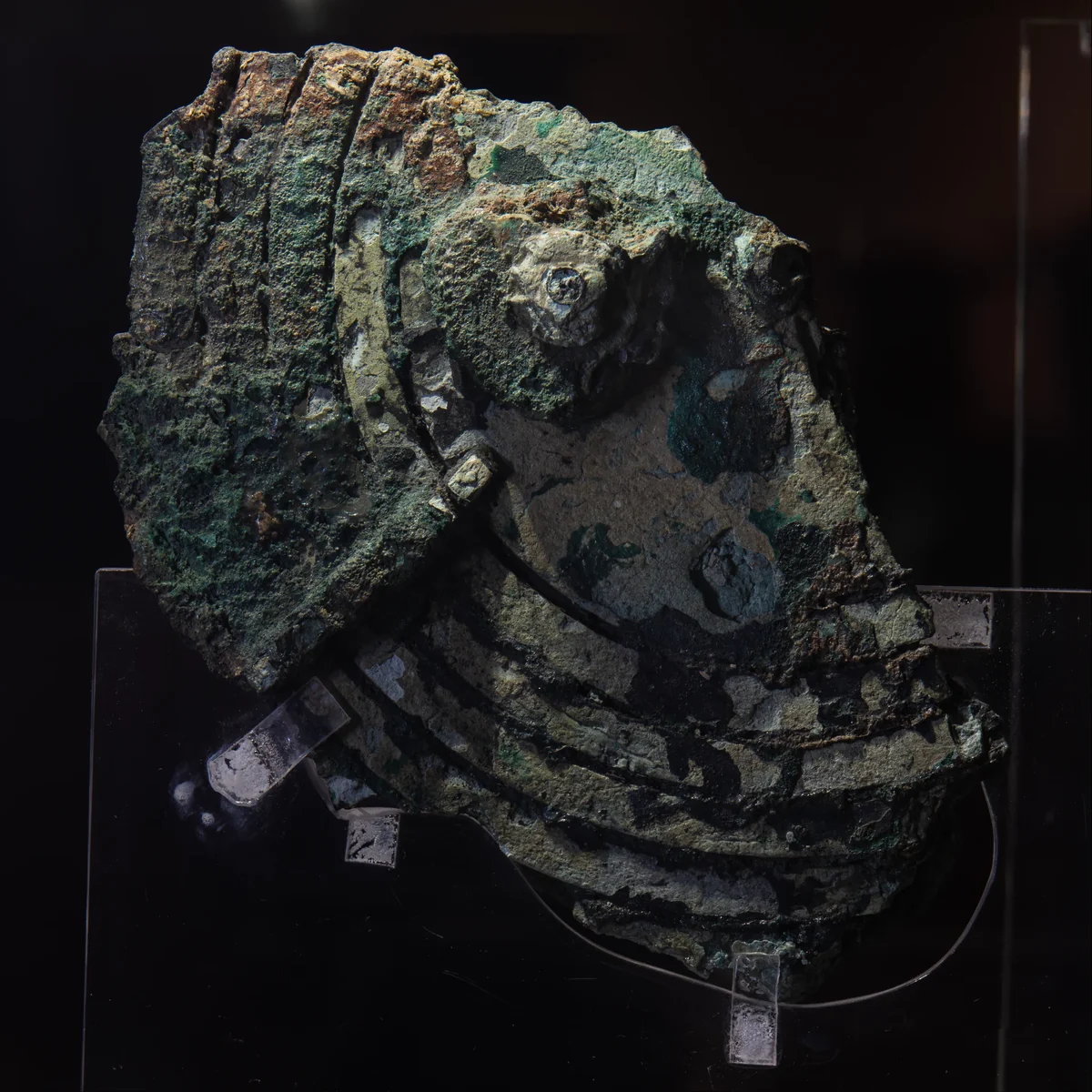
Fragment B: corroded bronze with part of the nineteen-year calendar spiral and a gear shaft
Fig. 04Fragment B, with part of the nineteen-year calendar spiral from the back of the machine, and a gear shaft. Photo: Logg Tandy, CC BY 4.0.

The back

One spiral dial kept a nineteen-year calendar, with a smaller dial for the four-year cycle of athletic games that included the Olympics. A second spiral counted the 223 months of the Saros cycle, and glyphs in about fifty of its cells marked the eclipses it predicted.

Nothing of comparable complexity is known for more than a thousand years afterwards, until the astronomical clocks of fourteenth-century Europe.

From bronze to the Risk Layer

The machine took a sky too tangled to follow by eye and made it readable, measurable and predictable. The Risk Protocol is building the same kind of machine for risk in crypto.

One engine, many readings

A single crank drove every dial on the machine. The Risk Protocol works the same way, with one Risk Engine powering SMART Tokens, Risk Prediction Markets and Risk Intelligence.

Uncertainty made usable

The machine turned cycles too long to track into positions, phases and eclipse warnings that anyone could read. We turn crypto risk into something people can hold, trade and forecast.

A layer you do not see

The gears sat inside the case, and what people saw were the dials. A layer is exactly that: machinery underneath that makes the surface make sense. It is why we call what we are building the Risk Layer of Crypto.

The mark in motion

Every detail has a reason

Close-up of the continuous rim

One unbroken rim

A single continuous ring carries every tooth and anchors every spoke. It stands for the layer itself: one piece of infrastructure that everything we build runs through.

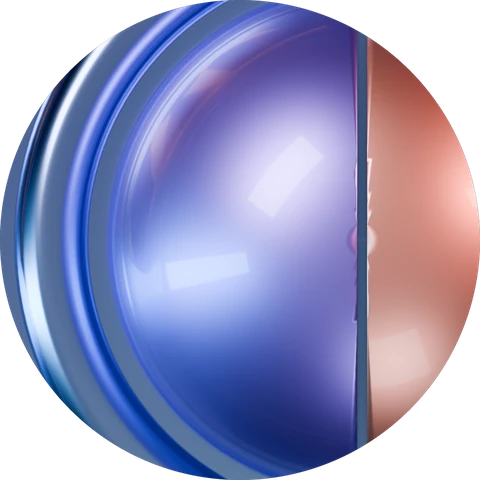
Close-up of the split moon

The split moon

On the original, a ball half white and half black turned to show the phase of the Moon. Ours shows risk split into two halves that always add back up to the whole, each held by whoever wants that side: stable or amplified, up or down, yes or no.

Close-up of the hub where the spokes meet

One hub

All three spokes meet at a single hub, the Risk Engine. Nothing on the wheel turns on its own; every product draws its motion from the same centre.

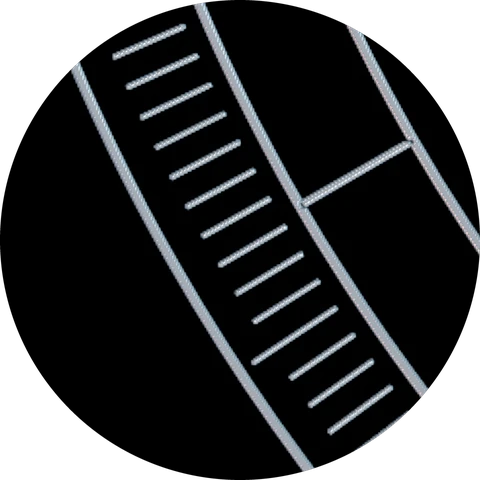
Close-up of the day marks on the dial

The dial

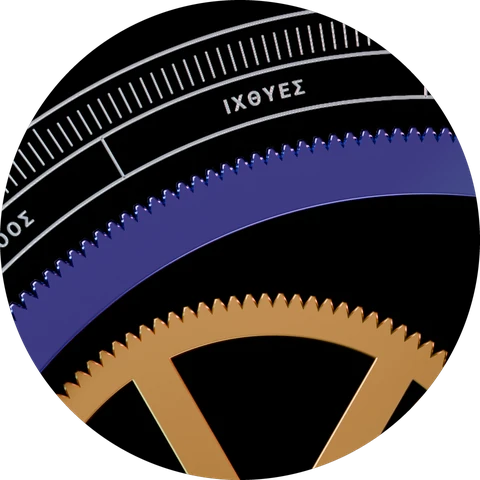
The original's front dial carried a ring of day marks and the signs of the zodiac. Ours carries 365 day marks, one for every day of the year in a market that never closes, engraved on a black face.

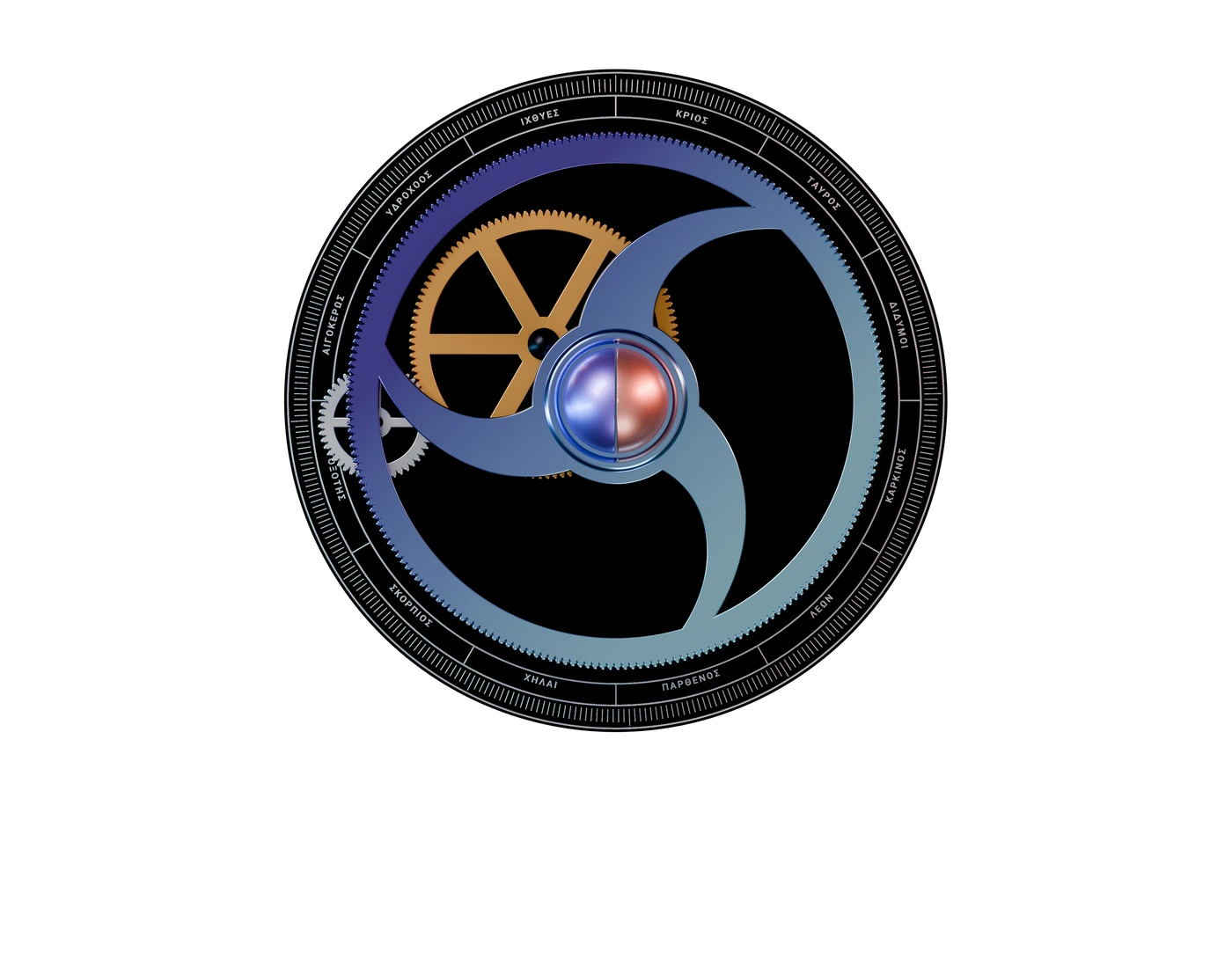
The rendered mark: the anodised wheel with three swept spokes over an engraved dial, with the split moon at its hub
Close-up of the anodised metal

The metal

The wheel is anodised in the brand gradient, from cyan to violet, with a machined highlight along its edges. Special editions come in platinum, and in bronze, the metal of the original.

Close-up of the triangular teeth

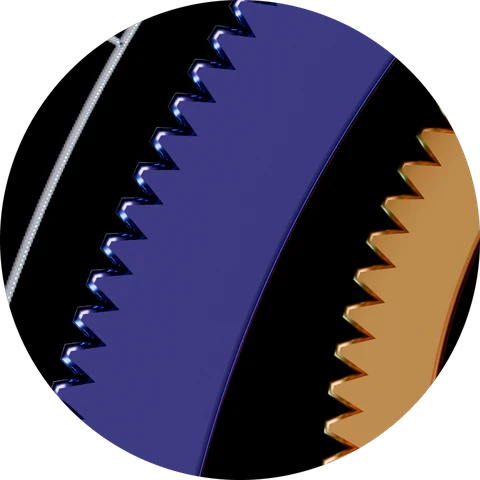
223 triangular teeth

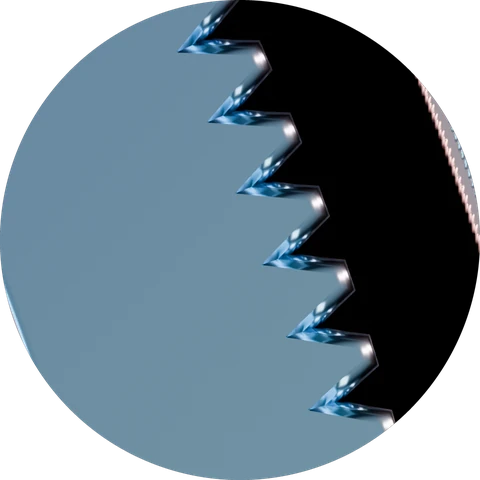
The rim carries 223 teeth, the best estimate for the great wheel that drove the original and the number of lunar months in the Saros eclipse cycle. Each tooth is a triangle, the profile of the original's hand-cut teeth.

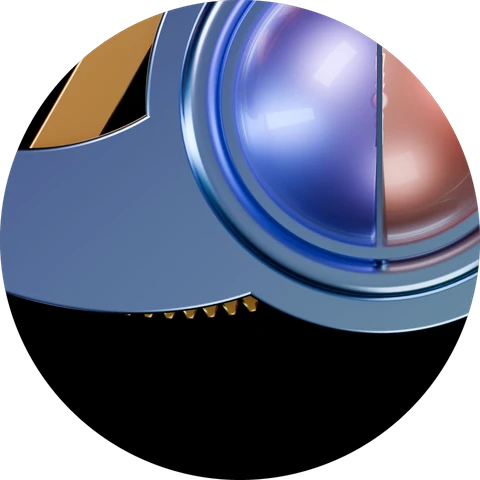
Close-up of the seam and the collar

The seam and the collar

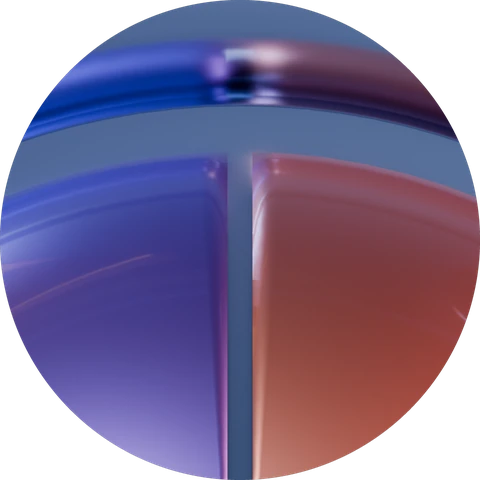
A hairline seam divides the halves. It is the split itself, the Split Mechanism for Asset Risk-Tokenisation that gives SMART Tokens their name. A collar holds both halves in one frame, because together they always add back up to the whole.

Close-up of a swept spoke

Three swept spokes

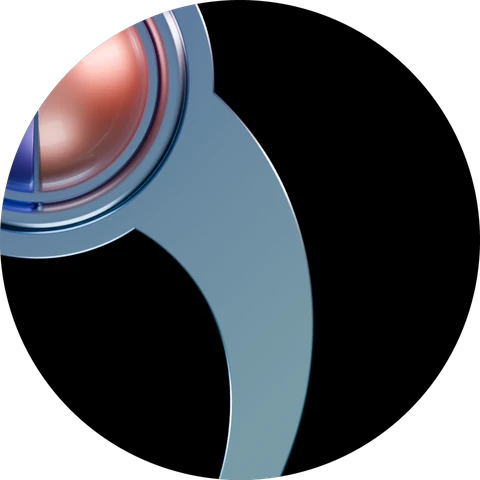
The original wheel has four straight spokes. Ours has three, one for each product on the Risk Engine: SMART Tokens, Risk Prediction Markets and Risk Intelligence. They are swept like turbine blades, so the wheel seems to turn even at rest.

A wheel with 223 teeth and four straight spokes, like the original
The original: four straight spokes
The mark's wheel with three swept spokes and the split moon
The mark: three swept spokes

Cast in metal

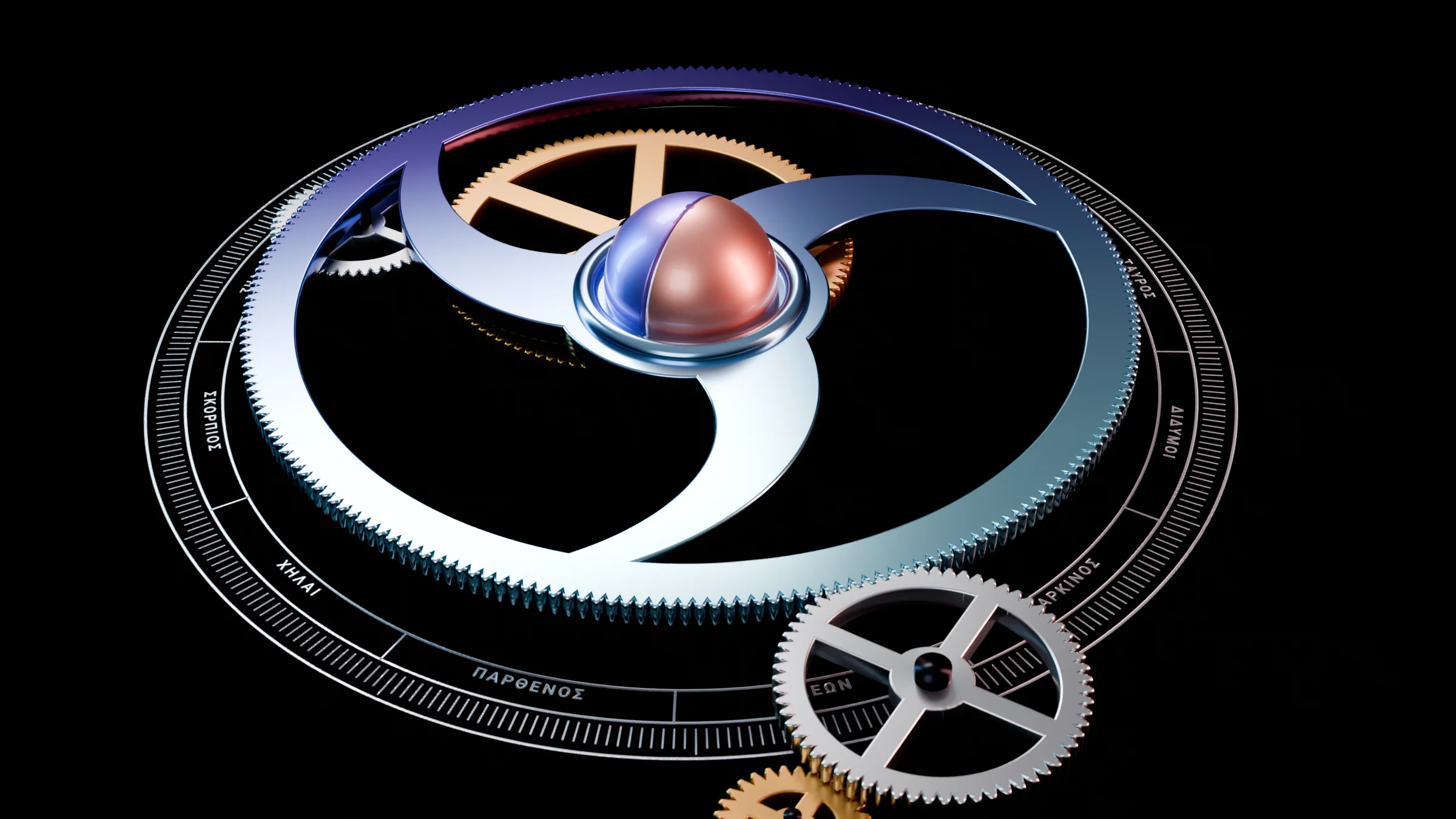
The mark in metal, three-quarter view
The anodised wheel over its engraved dial, with platinum and bronze gears turning beneath it.
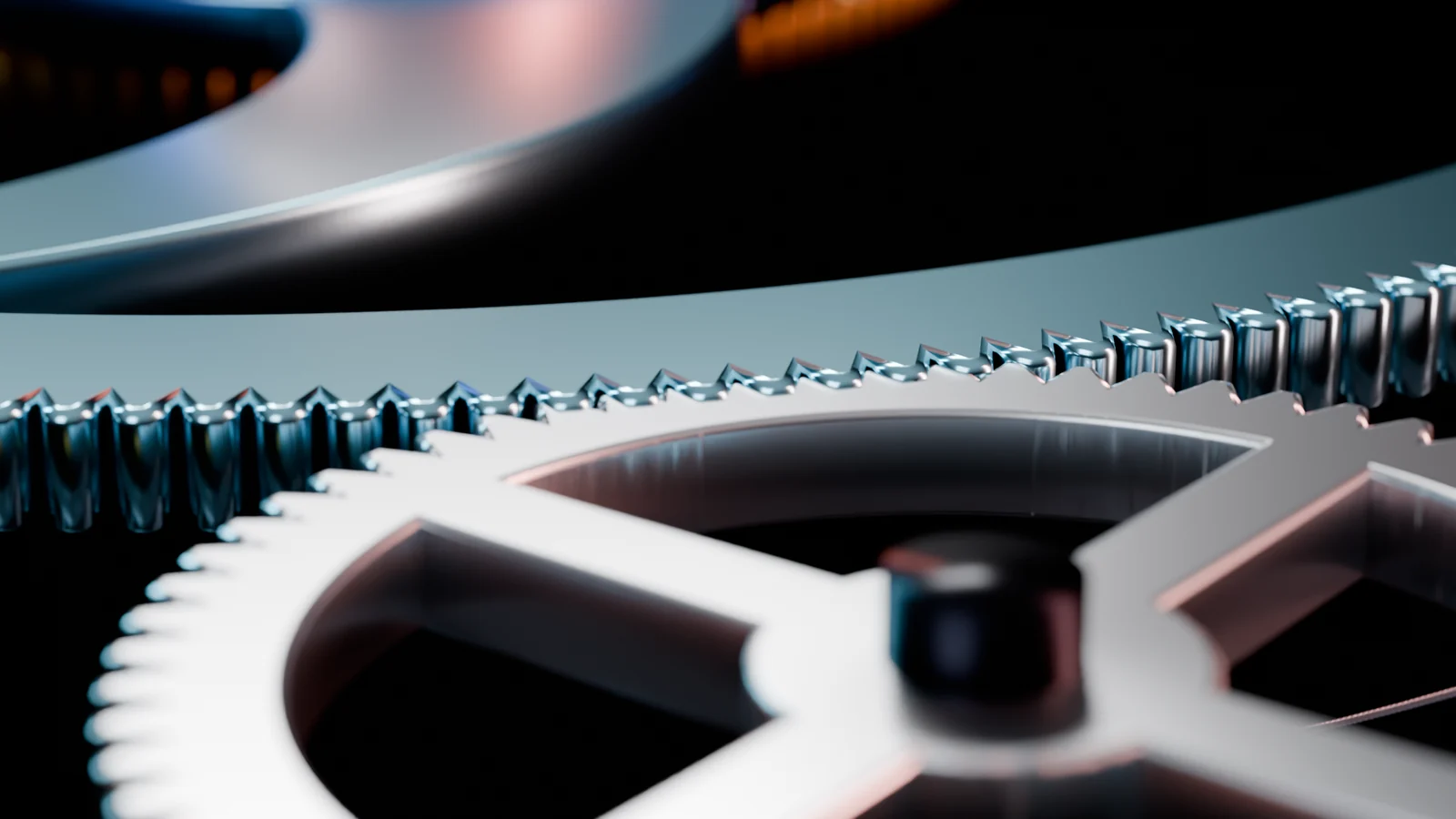
Macro view of the teeth meshing
Every gear shares the main wheel's tooth size, so the teeth mesh as they would in a working mechanism.
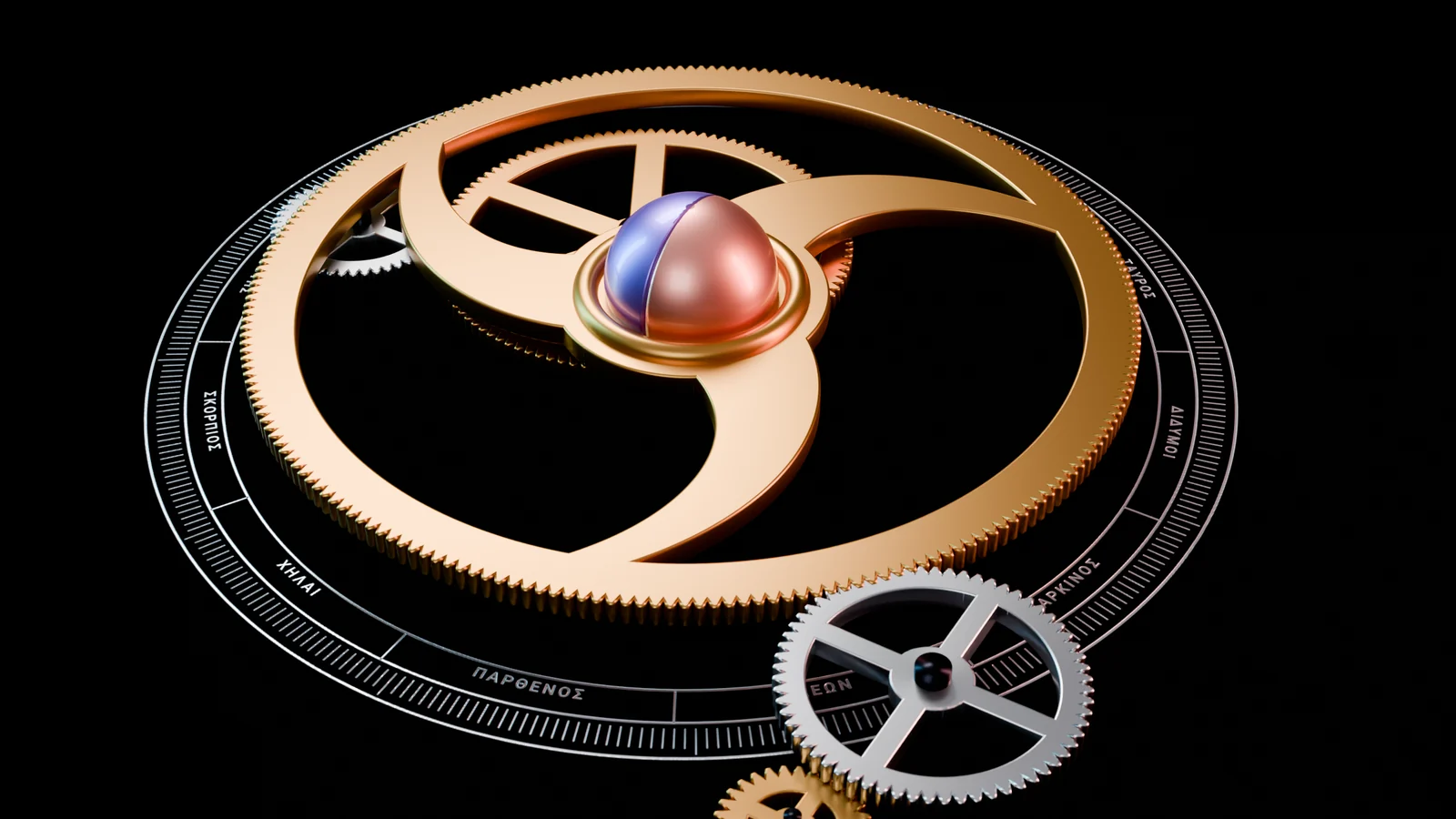
The bronze edition of the mark
The bronze edition, in the metal of the original.

The rendered edition

From about 200 pixels up, the mark appears in full metal, with its engraved zodiac ring, the bronze gear behind the wheel and the split moon.

Rendered horizontal lockup on black
Horizontal, rendered
Rendered stacked lockup on black
Stacked, on dark
Rendered stacked lockup on white
Stacked, on light
The rendered app icon
App icon
The rendered mark on black
The rendered mark
The rendered X banner
X banner, 1500 × 500

In use

Colour and type

Every flat colour in the mark comes from the brand palette. The metal finishes add lighter and darker tints of the same hues to give the metal its sheen.

Violet#7374BFOne half of the moon
Peach#F5A196The other half of the moon
Gradient cyan#6DC2DDWhere the metal starts
Gradient violet#7562B9Where the metal ends
Black#000000The dial
White#FFFFFFThe wordmark
THE RISK PROTOCOL set in Marcellus

The wordmark is set in Marcellus, a flared serif drawn from classic Roman inscription letters. The ship that carried the mechanism sank in the Roman era, and the machine itself was engraved with Greek capitals, so the name is cut the same way: in capitals, spaced wide, made to last. Roboto and Roboto Mono carry everything else.

The Antikythera MarkTHE RISK PROTOCOLThe Risk Layer of Crypto